
AAS SURGE Report on Undergraduate Astronomy/Astrophysics Majors
After two years of work, I'm thrilled to announce that the report from the American Astronomical Society (AAS) Education Committee's Subcommittee on UndeRgraduate and Graduate Astrophysics Education (SURGE), which I had the privilege of chairing in 2024–2025, is now publicly available on arXiv.
The headline finding: undergraduate astronomy and astrophysics degrees in the United States vary wildly across institutions. In other words, there is no shared understanding of what this important credential should mean among our community.
We surveyed 78 institutions representing roughly 1,000 majors annually, a substantial majority of the U.S. degree-granting programs, and found striking inconsistencies in the coursework and learning goals that constitute undergraduate astronomy and astrophysics majors. The result is that an "astrophysics major" at one institution can mean something very different from an "astrophysics major" at another, which has real consequences for graduate school admissions and for employers trying to interpret these credentials. It brings to light a really exciting opportunity for our field to discuss what a flexible, modern astrophysics major should be. What knowledge, skills, and competencies should all undergraduate majors share?
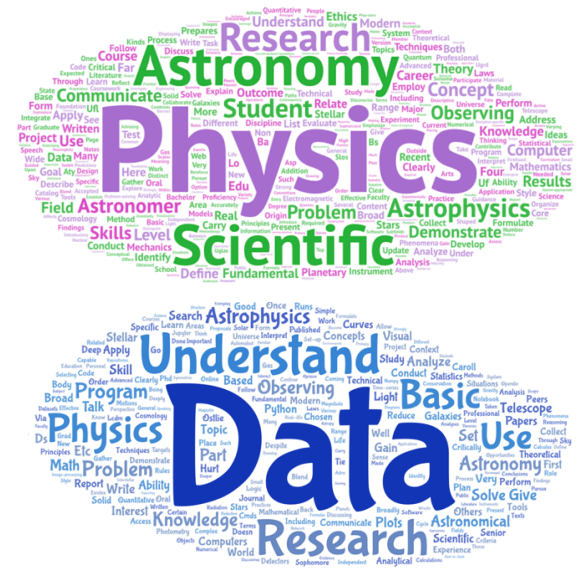
My favorite figure from the report is the one below showing two word clouds. The top was derived from the text of the formal learning goals for astronomy and astrophysics majors and the bottom represents responses to the question “What are the top three things you think every major from your program should know or be able to do upon completing your program?” (informal learning goals). The difference is striking, no?
The report contains 9 key findings and 10 recommendations. The recommendations are aimed primarily at degree-granting departments (lots of practical suggestions for how to think about your curriculum) and at the AAS itself. We tried hard to be constructive rather than prescriptive — there are lots of legitimate reasons that different programs look different, and the goal is not to totally homogenize but rather to ensure that there is some level of shared understanding of the knowledge, skills, and competencies.
If you'd rather read a shorter piece than the full report, Astrobites has done a wonderful writeup of some of the key findings.
Huge thanks to my fellow subcommittee members — Carl Ferkinhoff, Michael Foley, Meridith MacGregor, Melissa Morris, Karen Masters, Tom Rice, and Colin Wallace. This was a genuine team effort and I am proud of what we put together. We hope that this report is the beginning of a longer dialog about what an astronomy degree should be, and we welcome feedback from the community.