
Cailin's Thesis Published!
I'm thrilled to share that lab alumna Cailin Plunkett '23 has just published her first first-author paper in the Astronomical Journal. The paper, "Occurrence Rates of Accreting Companions from a New Method for Computing Emission-line Survey Sensitivity: Application to the Hα Giant Accreting Protoplanet Survey," is a beautiful piece of work that grew directly out of Cailin's Apker-Award-winning senior thesis here in the lab.
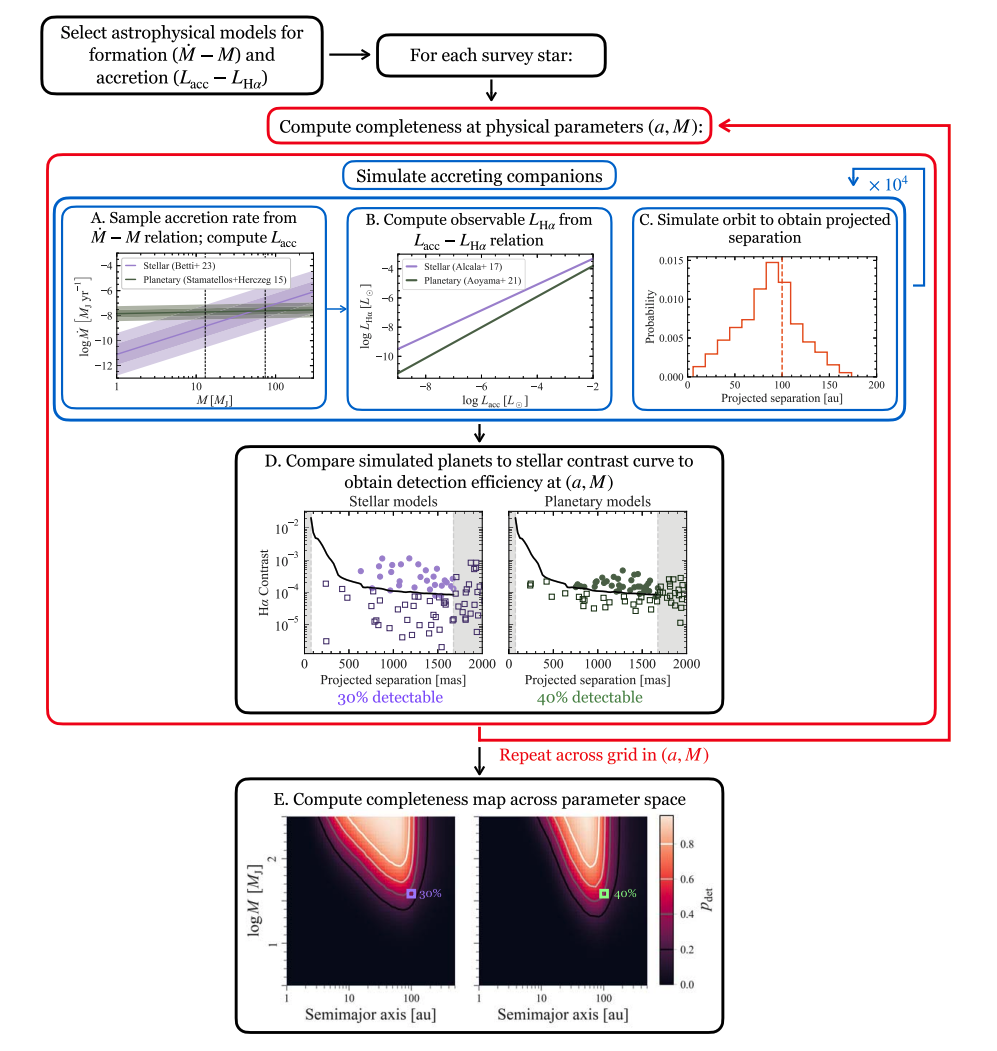
The core problem Cailin tackled is one that has nagged direct imagers for years: what can we actually conclude about the underlying population of planets when we conclude a survey? In particular, determining the properties of the planets we are NOT sensititve to requires a very careful accounting. For accreting protoplanets — whose observable brightness depends on a tangled chain of assumptions about formation physics, accretion physics, and extinction — this turns out to be extra hard. Cailin developed a new framework that propagates flexible assumptions about all of those intermediate steps. She applied it to the GAPlanetS dataset to produce the first statistical constraints on accreting companion occurrence rates in transitional disks. Under two different accretion model assumptions, she finds occurrence rates consistent with around 0.16–0.22 accreting companions per transitional disk system within ~200 au. Figure 1 above (reproduced from Plunkett+ 2025) shows the conceptual flow of the algorithm — a useful map of how the various pieces fit together.
The framework is general: it's designed to be applied to future Hα surveys (and, with adaptation, to surveys at other accretion-tracing wavelengths), which means Cailin's thesis methodology is going to keep paying dividends as the field grows.
Cailin is now a PhD student at MIT working with Salvatore Vitale on gravitational-wave astrophysics — she's studying the populations of merging black holes and neutron stars using statistical methods that bear a real family resemblance to the ones in this paper, even though the science is at the opposite end of the mass spectrum. It's been a particular delight to watch her undergraduate work continue to bear fruit even as she's launched into an entirely new corner of astrophysics. Congratulations, Cailin!