
A Big Week — JWST Data and an Accretion Conference in Heidelberg
This month I had the pleasure of attending the Gas Accretion in Planet Formation (GAP) conference at the Max Planck Institute for Astronomy in Heidelberg. I gave the opening keynote — "Toward Understanding Protoplanets as a Population" — to a room of about 60 colleagues working on every flavor of accretion question, from MHD modeling to direct imaging to ALMA disk surveys. I’ve never given an opening talk before, and it was a fun and interesting challenge to try and “set the stage” for a meeting!
A personal highlight was getting to see two lab alumni at the conference: Lillian Jiang (now a PhD student at UT Austin) and Kim Ward-Duong, who is of course not really an "alum" — she was the lab's first FCAD postdoc and remains a close collaborator at Smith College. Lillian was a Smith senior thesis student co-supervised between Kim and me back in 2022, and seeing her give an awesome talk on her PhD research at this conference was one of those full-circle moments that feel really nice. I of course don’t expect students to go into the same field as me, but for the few who do, I get this special chance to watch their careers more closely like this, and that’s super fun!
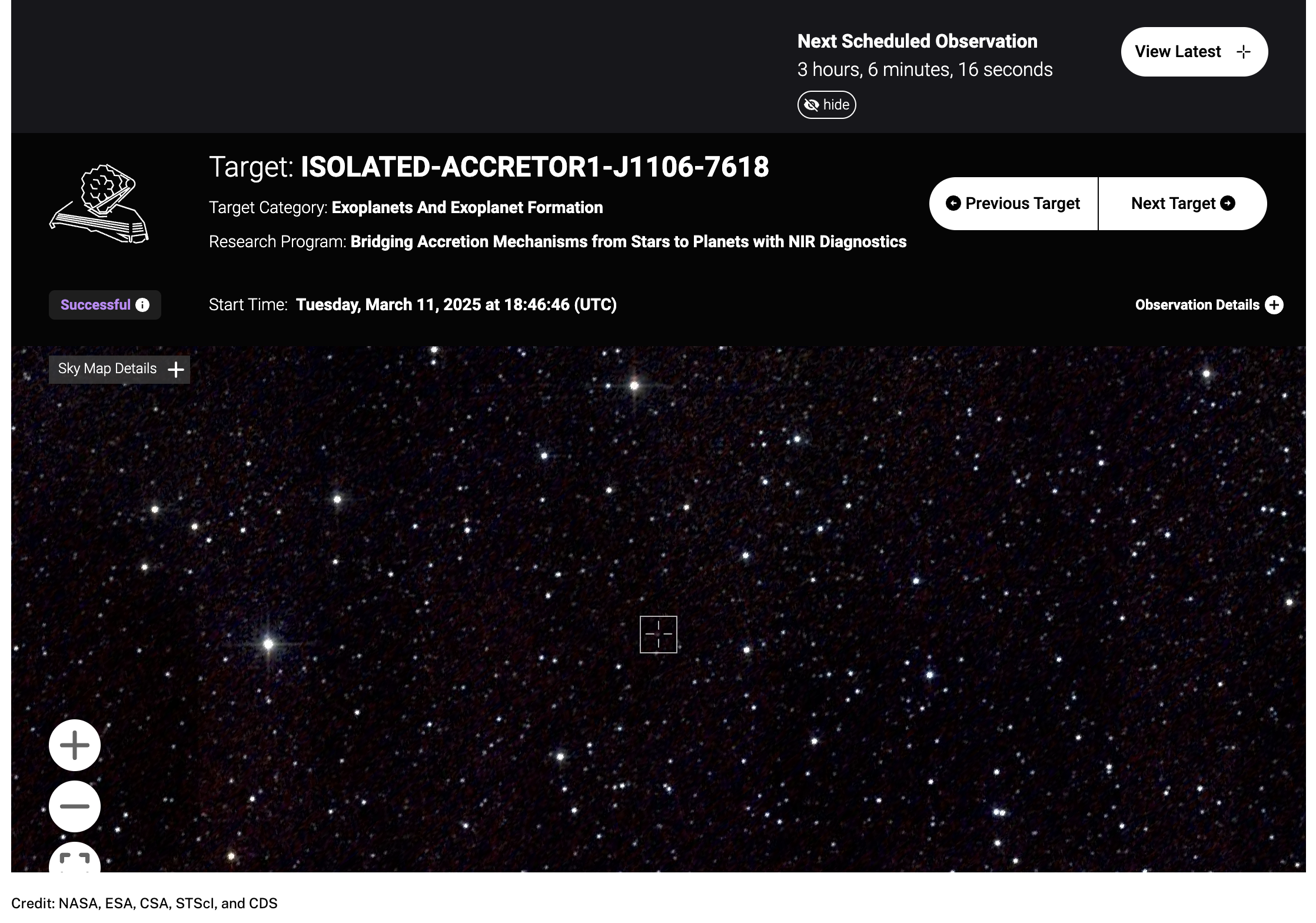
Meanwhile, on the same week as the conference, our long-awaited JWST Cycle 3 data finally came down. The program to observe six young brown dwarfs in the Chamaeleon star-forming region is my first time leading a space telescope observation. The screenshot below is from JWST's "Where Is Webb" public observation tracker on March 11, the day several of our six targets were in the queue. The spectra are gorgeous, with a wealth of accretion lines, molecular features, and ice signatures that we're just starting to make sense of. Stay tuned!
Adding to the excitement of the week: when we learned a few days earlier that our JWST observations were going to be moved up in the schedule, we scrambled to put together a VLT Director's Discretionary Time proposal to do simultaneous ground-based observing with MUSE and XSHOOTER on the Very Large Telescope. The DDT was approved while at the conference, and the observations executed the next day. We ended up using JWST plus two of the world's largest ground-based telescopes all in one night. Pretty much the pinnacle of my astronomical career so far!! Huge thanks to Justyn Campbell-White and Carlo Manara at ESO for helping us scramble to set up the VLT observations on short notice — this was very much not a thing that would have happened without them.