
A Scale Model of the Solar Neighborhood
ASTR 111 (Exploring the Cosmos) is back this fall after my year on sabbatical, and I'm enjoying the chance to teach it again with a few new experiments baked in. One of my favorite moments in the class is a lab I've been refining for several years: a 3D scale model of the solar neighborhood, built collaboratively in the science center atrium as a piece of transient public art.
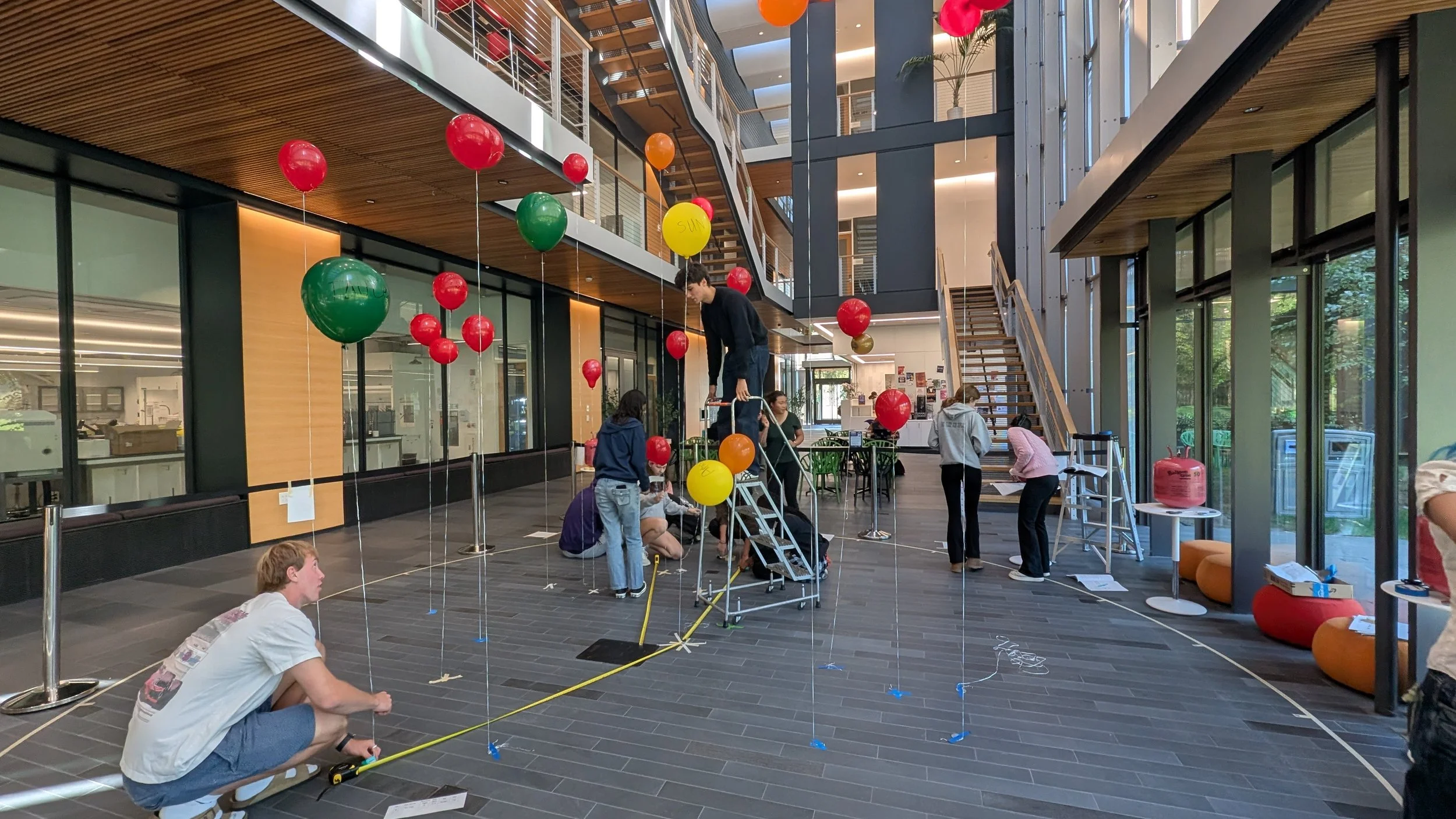
The basic premise: students start with a table listing every known star within 16 light years of the Sun — 70 of them, including double and triple systems, brown dwarfs, and white dwarfs. Each group takes a card with one star (or a gravitationally bound multiple star system) and constructs a balloon(s) to represent it. The Sun is a 10-inch yellow balloon at the center of the spherical model. The other stars get balloons sized and colored according to their spectral type — blue for A stars, green for F, yellow for G (like the Sun), orange for K, red for M, brown for brown dwarfs, with white dwarfs as little paper circles taped onto their companions. Students then place their balloons at the correct distance, direction, and height relative to the Sun, using a 1 light year = 0.5 feet scale, the right ascension circle taped off around the room, and "fist and finger" angular measurements to nail down each star's declination.
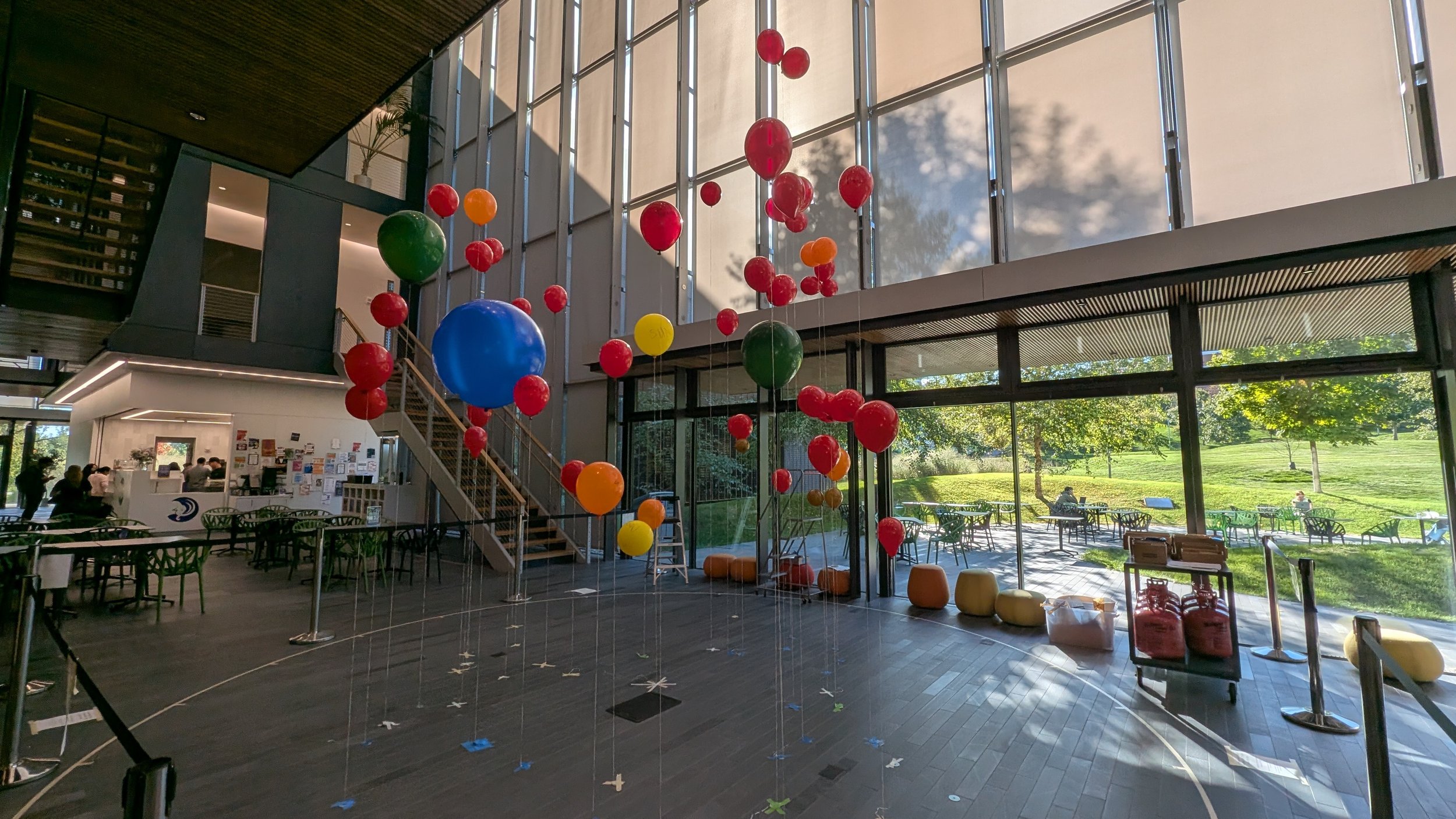
Watching it come together with people in the atrium looking on is one of the small joys of teaching this class. The students are doing real trigonometry (calculating distances along the floor from sight-line distance and declination), real spatial reasoning (translating RA/Dec into a physical 3D arrangement), and estimation (eyeballing balloon diameters against the table specifications). When it's all assembled, the model itself drives home some big ideas in a way that no lecture can: the solar neighborhood is overwhelmingly dominated by small red M stars, the Sun is one of only a handful of yellow balloons in the whole atrium, and the bright blue stars we see most readily with the naked eye in the night sky are almost entirely absent.
I've been planning for a while to make all of the ASTR 111 lab materials publicly available on this website, under a Creative Commons license so that other instructors can use and adapt them. This post is the first of what I hope will eventually be a full set. This lab is available here (CC BY-NC-SA 4.0 — feel free to adapt for your own classes; please credit and share alike). Stay tuned for more!